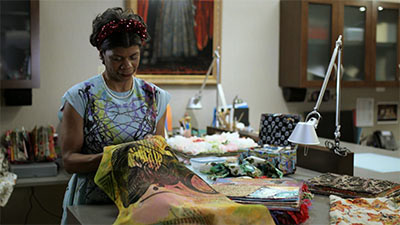
I am a book artist, printmaker, and writer. My practice merges textile traditions and historical book structures to create sculptural books. I work primarily with discontinued textiles, wedding dresses, and historic fabrics, and I treat these materials as witnesses to uncredited labor, memory, and cultural inheritance. My work reclaims domestic and textile labor of women whose contributions have often been excluded from formal archives.
Shakespeare’s sonnets function as conceptual frameworks through which I examine questions of preservation, reproduction, beauty, and love. By placing intimate histories of domestic textiles alongside canonical literature, I ask whose labor is preserved, whose stories are collected, and whose forms of knowledge survive. I call this methodology Material Excavation.
Through stitching and book arts, I approach making as a form of critical reading. The page becomes a site of accumulation where textiles carry histories alongside language itself. These investigations currently unfold through 52 Weeks of Shakespeare’s Sonnets, a year-long durational project of weekly textile-based responses to Shakespeare’s sonnets, and Love Sonnets from Shakespeare to Baltimore, an ongoing series exploring literary interpretation through histories of Black domestic labor, fashion, and material inheritance.
Grounded in the discipline of slow making, my practice treats the handmade book as both object and method of thought. My work has been acquired for the permanent collections of the Smithsonian National Museum of African Art, the National Museum of Women in the Arts, the Folger Shakespeare Library, and Ohio University Libraries.
Beyond the studio, this research continues through Coded Threads, my Substack dedicated to slow reading, cultural inheritance, and the evolving life of the handmade book.
Coded Threads by Suzanne Coley